Tuesday, December 16, 2014

Gone Girl

Information. That’s the real object of David Fincher’s obsession. It’s the reason he keeps coming back to police procedurals. In a world flooded with information, it is the job of the detective to wade through the mess to find the truth: Mills and Somerset (Se7en), Toschi and Graysmith (Zodiac), Blomkvist and Salander (The Girl with the Dragon Tattoo), they all fulfill the job in some capacity. In Gone Girl, Fincher’s latest, this thankless task falls to Detective Rhonda Boney. 

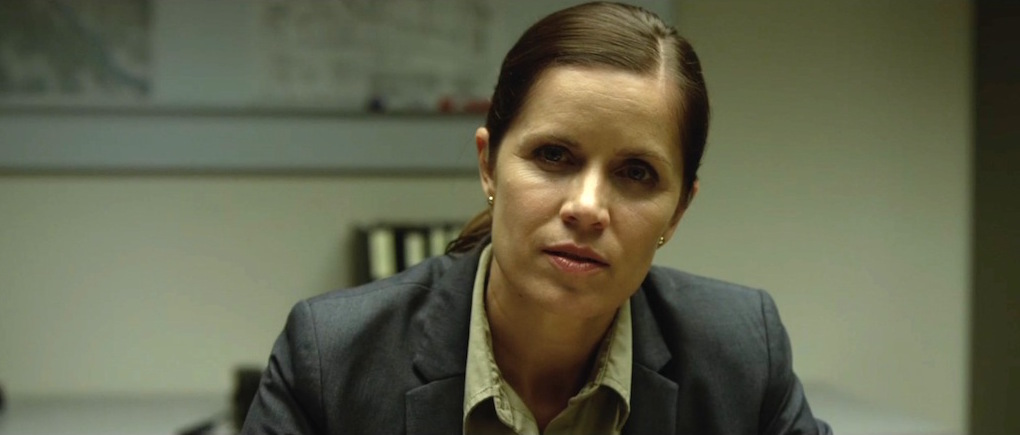
As played by Kim Dickens, Boney comes across as intelligent and empathetic. Like Fincher’s previous protagonists, she is meticulous and committed to her job. In many ways, she embodies the role of the prototypical Fincher protagonist but with one minor modification: she’s not the film’s protagonist. Gone Girl is not the story of a determined detective seeking the truth (like Zodiac or The Girl with the Dragon Tattoo). Instead, the film centers on the subjects of her investigation, Amy and Nick Dunne. 
At the start of the film, “Amazing” Amy Dunne (Rosamund Pike), the woman who inspired a popular children's book series, has gone missing. Rapidly, the high-profile case attracts the attention of the media who immediately hunt for a suspect, stumbling upon Amy’s husband, Nick (Ben Affleck.) At first, Nick seems innocent and distraught, but Fincher soon reveals that he had been having marital difficulties and an affair. The media quickly jumps on this and starts calling for his head. To counter this perception, Nick gives interviews in which he paints himself as a bad man who nonetheless loves his wife, a move that wins him some sympathy in his community. In retaliation, Amy, who turns out to have framed her husband, places anonymous calls to the police that point to Nick’s guilt. Gone Girl is structured around Nick and Amy’s manipulation of information to forward their agendas, and, in most instances, their manipulations work. Boney’s partner, for example, buys entirely into Amy’s staged narrative of her disappearance and would like to arrest Nick with little evidence to save himself the trouble of working on the case. Boney, the only character who resists manipulation, is pushed to the sidelines. 

As soon Fincher establishes that nearly all of his characters are either manipulative or subject to manipulation, Detective Boney, even though she does not get significant amounts of screen-time, becomes the only reliable surrogate through which the audience can view the film. Throughout, she is the only character who withholds judgement and looks for substantial evidence to carefully consider before accusing, let alone arresting, anyone. At first, she is hesitant to believe Nick was responsible for Amy’s disappearance, but at the same time, she knows that there is more to him than meets the eye and never comes to trust him completely. In the last part of the film, she becomes the sole crusader willing to question Amy’s shady captivity story and unlikely escape (which Amy invented to return home safely), but, in a sick twist of fate, no one onscreen acknowledges the truth she tries to pursue.
Like her idiot partner whose opinion constantly sways back and forth with that of the public, her superiors would rather believe in the story fed to them than to question the incongruities of Amy’s tale. Sadly, the hard work Boney puts into this hellish case ends up being for nothing. Kim Dickens’ resigned attitude in her final scene is heartbreaking. She’s not devastated or angered, she merely stops caring. In Fincher’s cruel world, only people like Amy, those who can dexterously manipulate information, succeed. 

In the end, Gone Girl is not a tragedy because Nick is forced into a life with the psychopathic Amy; the two twisted souls deserve each other. The film is a tragedy because Boney, the only person equipped with uncovering the truth, gives up the fight. Her work of finding out the truth, revealing the real criminal (central to films like Zodiac and Se7en) has been marginalized. Boney accepts that the truth doesn't matter nearly as much as public opinion. In a world where people would rather turn away from reality than tarnish the pristine image of Amazing Amy and her perfect family, there is nothing she can do, and it is terrifying. 

Verdict- 4/4
Gone Girl (2014) 2h 29min. R. 

Random Thoughts 
- Rosamund Pike, who plays Amy, has been doing great work for years now but has just now gotten the recognition she deserves. She's amazing, as always, but Kim Dickens is simply better this time around. For more of Pike's work check out her role as Bond Girl Miranda Frost in Die Another Day and Jane Bennet in Pride and Prejudice. 
- Watch Deadwood! Kim Dickens plays Joanie Stubbs. 
- Ben Affleck never stopped being a great actor. Here's more proof. 
- And Tyler Perry shows up as a crooked lawyer who turns out to be the character with the most integrity because this is a David Fincher film. 
- Neil Patrick Harris is in here too. This movie is a treasure trove of incredible actors. 

Thursday, December 11, 2014

A Most Wanted Man

A Most Wanted Man begins with a closeup of a harbor in Hamburg, Germany. Waves rhythmically crash against the cracked stone structure of the piers, probing its defenses. Onscreen text informs the audience that Mohammad Atta conceived the September 11 attacks from that city, an event that went ignored by it’s inefficient intelligence community. Since then, it says, Hamburg has been on high alert, intent on not repeating past mistakes. Immediately afterward, director Anton Corbjin cuts to a man, later identified as Issa Karpov, as he suspiciously rises out of the water and, with the cover of the night, disappears into the open, unprotected city. In a few minutes, Corbin effectively establishes the paranoia that took a hold of the city after 9/11, and he works hard to build that same fear in his audience. He forces it to ask, is this Hamburg’s next mistake? The world’s next threat?

The rest of the film focuses on the efforts of several individuals, many of them spies, as they struggle to locate and deal with Karpov and what he might represent. Gunther Bachman (Philip Seymour Hoffman), a German spy, leads the chase for Karpov with a team that includes his protege, Erna Frey (a fantastic Nina Hoss), and an American diplomat, Martha Sullyvan (Robin Wright). The case later involves Karpov’s reluctant banker Tommy Brue (Willem Dafoe) and the goodhearted lawyer Annabel Richter (Rachel McAdams) who decides, against all advice, to defend Karpov. All of the characters are forced to ask themselves tough questions. None is spared: Who are these “terrorists” we deal with regularly? Why do the act the way they do? Most of them would like to believe in the innate goodness of themselves and other people, but the memory of the attacks linger in their minds, making them adopt a “guilty until proven innocent” mindset that by the end of the film proves catastrophic for all involved. 


While Corbjin exploits the political atmosphere of the post 9/11 world, he restrains himself from ever declaring a political agenda. He is not concerned, for example, with the morality or effectivity of torture, nor does he make a case for or against intelligence institutions and their increasing prominence in recent years. Yes, torture is a part of our world. Yes, institutions like the CIA have massive powers that they didn’t have before. But Corbjin doesn’t use these universally accepted truths to make argue for or against a political position. Instead, he uses them to explore how they have affected the people involved with them. In that way, A Most Wanted Man is more philosophical than political in the question it raises. “Every good man has a little bit of bad, doesn’t he?” the cynical Martha tells Gunther. In this modern, post 9/11 world where people are inclined to see the worst in each other, A Most Wanted Man dares to see the best, and central to this viewpoint is Philip Seymour Hoffman's humanizing performance.

Hoffman plays Gunther as a disillusioned, beaten down spy. Gunther’s job consists mostly of gathering information, talking with his sources, and persuading other people to help him achieve his goal. He is the anti-cinematic spy, which is to say real life spies probably have jobs more akin to his than to that of any other spy ever depicted onscreen. Hoffman’s labored breathing and broken expressions convey the great weight the job has on Gunther, but no matter how hard it gets, he keeps pushing through “to make the world a safer place,” an idea that makes the horrors of his job bearable.
There are so many tired tropes Corbjin could have lazily relied upon, not just with Gunther, the hardened spy, but with the rest of the characters as well: the evil businessman (played, of course by the devilish Willem Dafoe), the seemingly peaceful Muslim who is lured by the terrorist cause, the naive idealist lawyer whose rosy world view is shattered by the events of the film. It’s a miracle that none of these characters ever become as simple as they could have been. Take Dr. Faisal Abdullah, a suspected terrorist whom Gunther and his team closely survey. He could have easily been the big bad bearded terrorist out to destroy Western civilization. Instead, he turns out to be a genuine philanthropist and a family man with a strong bond to his son. Though he’s not shown much, Corbjin makes an effort to understand him, and so does Gunther in a powerful scene in which he tries to think through the other man’s motivation. Both see the humanity in a person many would like to believe is a faceless monster. 

In the end, the film is optimistic in that it truly believes in the efforts of its protagonists, but it is never delusional. It ends with a (literal) crash that seems to wake up its characters to their harsh realities. Corbjin does not pretend that a few good people will change the way society behaves. What they can do, he seems to say, is to keep working on changing the minds of the majority until they see the light, but that takes time and effort, generations, even. (The film is full of sons intent on correcting the mistakes of their fathers.) In that sense A Most Wanted Man is neither like the idealistic "The West Wing" (1999) nor the hopeless "House of Cards" (2013) (two of the representative pre/post 9/11 examples of political filmmaking), but it's certainly a step in the right direction.

Verdict- 3.5/4
A Most Wanted Man (2014) 2h 2min. R.

Thursday, November 20, 2014

Five Perfect Scenes

A few simple scenes that demonstrate what it’s like to transmit meaning (ideas, emotions) through purely cinematic means: 

1) A father shares a rare moment of kindness with his son. Look at how the natural lighting (only the sun and source light seen onscreen) enhances the purely organic and spontaneous nature scene that takes the father by surprise. See the joy in his son’s face and the resentment in the other brother, lurking in the background (his thoughts are later heard through voiceover). 

 The Tree of Life dir. Terrence Malick: 

2) Two strangers realize that, perhaps, they are in love. Lack of editing is as important as splicing a film into pieces. Performance and perfect timing are also essential to make the scene work. They both know that the other is looking, but they never make eye contact. Listen to the lyrics, which the characters can hear as well. 

Before Sunrise dir. Richard Linklater: 


3) A long a waited reunion. The narrator anticipates the scene and builds up its importance. Nico’s “These Days” is perhaps the most perfect musical moment in film. 

 The Royal Tenenbaums dir. Wes Anderson:

4) A lie is exposed, and a marriage disintegrates in just three minutes. This is a more classically constructed scene with a focus on precise lighting, camera movement and controlled performances (save for one unhinged character). It also has a great beginning (the door to Michael’s office opens), middle (accompanied by rising action as Connie and Kay confront Michael, who denies all accusations), and end (with a beautiful cliffhanger as the door is shut on Kay’s face the moment she realizes the true nature of her husband).The music here is noticeable, but (like the almost invisible editing), it is subtle and doesn’t take precedence over the dialogue. 

 The Godfather dir. Francis Ford Coppola: 

5) Sometimes, to make a scene work, all you really need is a beautifully scripted monologue to come in at an opportune moment. Arguably, the purest, most honest moment in film. 

A Charlie Brown Christmas dir. Bill Melendez:

Bonus) Movies are made of images. If you’ve ever seen any movie, even if you’re not the kind to recall particular shots, you have at least one image stored permanently in your memory; that image is in this scene. Movies can make people fly. 

E.T. the Extra-Terrestrial dir. Steven Spielberg:


Saturday, October 25, 2014

Boyhood


In his review of the six hour Italian epicThe Best of Youth, Roger Ebert commented that “the two hour limit on most films makes them short stories. The Best of Youth is a novel.”  “When you hear that it is six hours long,” he tells the reader, “reflect that it is therefore also six hours deep.” Boyhood is not nearly six hours long, and yet it’s running time doesn't begin to scratch its surface. While it runs shy of three hours long, Boyhood remains, simultaneously, twelve years deep, old and wise.

Around the year 2002, director Richard Linklater, known by that point for his romantic one-off Before Sunrise, decided that he would make a movie that would span twelve years and track the development of a kid from age six into young adulthood. He would film during the summers in his home state of Texas, and he would then wait and see where the project took him, advancing without a solid script. Miraculously, his dream came true when the film was financed by IFC Films, and he began to shoot later that year. Since 2002, Linklater’s School of Rock and Bad News Bears remake helped sharpen his comic sensibilities and allowed him to learn to work with kids. Meanwhile, the homegrown Bernie, based on a local newspaper’s story, solidified Linklater’s standing as a proud Texan filmmaker. More timed passed. Before Sunrise gave way to Before Sunset which evolved to include Before Midnight to form a masterful trilogy on the passage time, the meaning of love and the beauties and hardships of marriage. As Linklater matured as an artist, he chipped away at Boyhood and applied his knowledge towards filming and editing it, until finally, earlier this year, he unveiled it to the public. The result? One of the most audacious, breathtaking and humbling artistic achievements I’ve ever witnessed, and one unlikely to be equalled in stature any time soon.  

The first shot of Boyhood is of the open blue sky. In the second shot, we see Mason (Ellar Coltrane), a six year old boy, looking up at this sky, dreaming. His parents have gotten divorced, which we later find out, so perhaps he's contemplating the fact. It is the first major event that will shape who he will become. The movie follows an odd structure that emphasizes the seemingly insignificant moments of everyday life. Mason grows a bit older with each subsequent scene. He learns to ride a bike, and he begins to question the existence of fairies and magic, nothing momentous. His mom remarries (twice) and so does his dad, but the weddings are never shown. Presumably Mason and his sister, Samantha (Lorelei Linklater, the director’s daughter), have birthdays, though they are also bypassed. These weddings and birthdays, major events people normally use as markers in their lives, are less important than the effects they have. Linklater is not interested in the cataclysmic events that determine our lives. Those are boring, since they make up the subject of every other film out there. Instead, Linklater implicitly points towards these events by showing their results. 
One of the most common criticisms issued against the film is that Mason “doesn't do anything,” but that he simply “reacts to things." That is correct, in most respects. But, why is this such a bad thing? It’s challenging and decidedly untraditional, but Boyhood, from its contemplative beginning onwards, announces itself as different. Mason is not intended to be anything like a typical protagonist. Listening to “Hero” (by Family of the Year), the song Mason plays as he drives away to college, reveals Linklater’s intention concerning Mason. With the song’s lyrics and a couple of visual gestures -- like Mason stumbling upon the song on the radio but then cranking up the volume -- Linklater tells us everything we need to know about Mason: “Let me go / I don’t wanna be your hero / I don’t wanna to be a big man / I just want to fight with everyone else… Everyone deserves a chance to / Walk with everyone else.” Mason refuses to be special. He will not conform to what audiences expect of him, to the ideals of a traditional movie hero, and it’s exhilarating. He is passive and observant (a defiantly unheroic characteristic), traits established in the first shot of the movie, traits that later evolve into a love for photography. At the same time, Mason is not spineless, and he possesses a constant moral core.  He works hard in both his day job at a restaurant and his hobby as photographer. He stands up to his drunk stepfathers at home, and he has sense enough not only for when to listen to the adults in his life, but also for when to discard their advice, which he learns to do when he finds out that they are mostly just as screwed up as he is. In other words, Mason is unheroic, but not an antihero. He’s more complicated than either category. He’s human. 

As various scenes roll by, we become deeply aware of the passage of time. Even though it happens imperceptibly from one scene to the next, the cumulative effect is outstanding: Mason learns to drink. Unrelated, he buys a car. He also gets his heart broken once or twice. All of a sudden, the kid who was six at the start of the film, under three hours ago, drives off to college! For the most part, both characters and actors end up gracefully aging into their roles. Patricia Arquette as Olivia, Mason’s mom, gives what may be the most impressive performance of the film by expertly balancing a character constantly teetering on the edge of failure and despair. Olivia is always a mess, but at the same time she raises both of her kids admirably, and she incessantly improves herself by getting a degree in psychology and then working up to a teaching position at a university. Her arduous journey ends up being the most satisfying of all, not least because she’s the character whose odds of succeeding were mostly stacked against her. Mason Sr, played by the great Ethan Hawke, begins as the most irritating character (not too many will be forgiving towards his stoner/absentee dad), but he slowly transforms from a heedless free-spirit into the husky, wise voice of reason -- a change solidified by Hawke’s changing, coarsening voice which was greatly altered by the actor’s smoking habit -- until he eventually becomes the father Mason never had growing up. “We’re all just winging it,” he counsels his distressed son. A nugget of wisdom that Boyhood offers through him: No one has their lives figured out, but they’re all just “winging it,” doing their best to lead good lives. 
Part of the unexpected tragedy of Boyhood comes from scenes in which characters look back on their lives and, using the perspective gained through time, examine their past mistakes. Mason Sr, then, after remarrying and becoming an active father, regrets being the absentee dad to his oldest kids, while Olivia wishes she had broken free from the several drunk boyfriends who curbed her potential and made Mason into a bit of an anti-authoritative rebel. Although it is lovely to witness these two people mature and find a measure of stability over time, it becomes hard not to wonder. Boyhood raises the question of what it would have been like had they known better before they irrevocably altered their lives forever. Olivia says something to that effect, that she would have eagerly embraced Mason Sr if he had just gotten his act together a little earlier in life. The bitterness of looking back, of “what ifs,” has rarely stung so hard. 
Mason, too, even though he’s not old enough for past mistakes to really haunt him yet, also learns a lot from his countless experiences chronicled in the movie, experiences which alter him imperceptibly and quietly shape who he becomes. Midway through the film, for example, the previously insignificant moment in which Mason’s stepfather gives him a camera becomes a major event, since it provides Mason a focus that will propel him towards college, where he eventually goes to study photography. After that, he’s on his own as the movie simply and quietly concludes without a grand finale or any unifying statement. Life goes on. 
There is something incredibly moving, wonderful, and painful in seeing a child grow up onscreen that can't easily be put into words. Even if the execution of this incredible concept had been botched, Boyhood would still have been worthy of admiration, but Linklater somehow pulled it off, in large part because Ellar Coltrane matured into a such a charming and captivating figure. He was good as the dreamy eyed boy seen in the film's poster, but he grows into his role as the film goes on, becoming more subtle, intelligent, and articulate as time passes and he changes with his character. I can't imagine all the ways this project must have affected Coltrane's life, but I'm grateful he stuck through it all. His performance is a gift, which, like Boyhood itself, I had never seen before and probably will not see again in quite some time, if at all.

Verdict- 4/4
Boyhood (2014) 2h 46min. R. 


Monday, September 22, 2014

Begin Again and the Personal Film.

In late August, after its initial theatrical run, Begin Again was re-released by the Weinstein company, presumably as an attempt to garner awards recognition. Though the script, acting, and directing are uniformly excellent, the move seems to be geared towards giving the maximum amount of exposure to the music of the film, the element most likely to score nominations, and deservedly so.

Writer-director John Carney has managed to make the rarest of musicals: that in which the music plays a pivotal role in the shaping of the story. Begin Again opens with the serendipitous encounter of Gretta (Keira Knightley), a down on her luck musician, and Dan (Mark Ruffalo), an unsuccessful producer, who decide, on a whim, to record an album together. The movie that follows is not only populated with several original songs, but it also contains a multitude of character musicians, producers, professional and amateur instrumentalists, and music critics. 

For the main characters, however, music transcends their professions. With two of his features (this and Once), Carney has demonstrated a keen understanding of how music moves and influences people.Take, for example, the scene in which Greta prepares to have dinner with her rockstar boyfriend, Dave, on his first night back from a trip. The mood is quiet and romantic, that is until he decides to share with her a song that he composed on the road. Quickly, a tension invades the scene; Carney holds on a lengthy shot of Greta as she listens to the song, slowly realizing that the love interest Dave so ardently sings about is not her. Carney neither shows nor explains Dave’s infidelity, but he doesn’t have to. The lyrics of the song and Keira Knightley’s pained expression are enough. 

In another pivotal scene, a suicidal Dan walks into a bar.  There, he sees a young woman with a beat up guitar singing a song about that irrevocable “step you can’t take back,” a step  Dan was all too ready to take until that beautiful melody stopped him in his tracks. During the song, every extraneous sound drifts away on the soundtrack. That simple act of letting the background noise subside lends an incredible weight to the song. Dan, who was ready to kill himself, literally drowns out everything else; he begins to live for the music.
Originally, the film had the captivating title, “Can a Song Save Your Life?” a question Carney enthusiastically answers in the affirmative. Carney, a musician, carefully crafted the film’s soundtrack, writing two critical songs, including “A Step You Can’t Take Back,” the catalyst for the film. His personal involvement with, and dedication to, Begin Again reminded me of two other recent films from directors who went beyond what is traditionally called for in a director to faithfully bring their visions to the screen, and who have proven, through the success of their films that there is a place for small-scaled personal films amidst the wasteland of impersonal blockbusters (read Trans4mers) that populate Hollywood today. 

In Chef, director Jon Favreau set out to make an independent, low-stakes film to take a break from the massive superhero movies that had consumed his career. Instead of music, however, Favreau focused on the ways food can bring people closer together. Favreau, who both wrote and directed, plays a chef who leaves a high end restaurant to open up a Cuban cuisine food truck, a project that helps him reunite with his estranged son. As can be seen in a mid-credits scene, Favreau learned to cook for the film. He was so inspired by the culture he was representing that he took the extra effort to bring it to the screen in the most authentic way possible. The result is some of the most delicious food I’ve ever seen onscreen.   
Joss Whedon’s adaptation of Shakespeare’s classic comedy about love and betrayal, Much Ado About Nothing, also has the spark that made Chef and Begin Again so special. Although mostly keeping close to the original play, Whedon made a few key changes that reveal his modern, more cynical sensibilities. The film, though not explicit, is more sexually open, externalizing subtext that is hidden in the play. In one of his shrewdest departures from the original, Whedon shows that before the events of the film, the infamous couple, Benedick and Beatrice, had had an affair that ended painfully, a fascinating bit of exposition that complicates their relationship afterwards. It’s dark and painful, and provides one more obstacle they have to overcome before choosing to commit to a romantic relationship, but it makes the film’s ending much more satisfying. Whedon also financed the film and shot it at his home, a testament to his dedication to the project. 
Begin Again, Chef, and Much Ado, may be about universal subjects — music, food, and romantic love respectively — but the directors of each finds a particular way of demonstrating what they find so attractive about each, giving audiences one of the great gifts a movie can give: a glimpse into the mind of its maker.