Thursday, February 14, 2013

Roger Deakins

He was born in Devon, England 1949. He studied at the National Film and Television School of England. He has been nominated for 10 Oscars, as well as 11 American Society of Cinematographers Awards, winning 3. He is the greatest living photographer in the world. His name is Roger Deakins. Here are just a few of his memorable pictures.
Skyfall (2012)
In Time (2011)
True Grit (2010)
The Company Men (2010)
Revolutionary Road (2008)
Doubt (2008)
No Country for Old Men (2007)
The Assassination of Jesse James (2007)
House of Sand and Fog (2003)
A Beautiful Mind (2001)
The Man Who Wasn't There (2001)
O Brother, Where Art Thou (2000)
The Big Lebowski (1998)
Fargo (1996)
The Shawshank Redemption (1994)

Thursday, February 7, 2013

Oscar Predictions


Best Picture 
Amour 
Argo
Beasts of the Southern Wild
Django Unchained
Life of Pie
Lincoln 
Les Miserables 
Silver Linings Playbook
Zero Dark Thirty 

Should Win- Zero Dark Thirty: I've seen it twice now, and I don't think any new movie this year will match it ( but I hope I'm wrong!). It is chilling to watch Jessica Chastain's Maya slowly harden at the sight of war and torture, only to break down at the last second. The final shot of the film is breathtaking, and reason enough for this film to deserve its nomination. 

Will Win- Argo: It's a fun movie. I won't be angry if it wins, but it does not deserve it. Lincoln is the other top contender. The Academy does love a great historical biopic (see The King's Speech) and Lincoln is among the best. However, if there's one thing that it loves more, then that would be a great movie about movies (The Artist, for example). 

Best Director 
Michael Haneke (Amour)
Benh Zeitlin (Beasts of the Southern Wild)
Ang Lee (Life of Pi)
Steven Spielberg (Lincoln)
David O. Russell (Silver Linings Playbook)

Should Win- Steven Spielberg: I once asked my film professor what exactly he meant by "classical Hollywood style." He pointed me towards the films Steven Spielberg, and said, "that." Every shot has meaning, and advances the story. Every cut is motivated. You see exactly what is necessary to tell the story (nothing more, nothing less), exactly what Spielberg wants you to see. Spielberg made two more crucial choices. First, he personally convinced Daniel Day Lewis to play the beloved 16th president. Second, he narrowed his story down to the final months of the Civil War and Lincoln's life. Within this time period he found the compelling story of the ratification of the 13th Amendment. The result is a lean and focused 2:30 hour masterpiece. 

Will Win- Steven Spielberg: The Academy loves him, and it's been a while since he won for Saving Private Ryan. 

Best Actor in a Leading Role
Bradley Cooper (Silver Linings Playbook)
Daniel Day Lewis (Lincoln)
Hugh Jackman (Les Miserables)
Joaquin Phoenix (The Master)
Denzel Washington (Flight)

Should Win- Bradley Cooper: Mercurial. The role of Pat Solitano would have been disastrous in the hands of the wrong actor. Instead, its miraculous. My favorite scene involves Hemingway. If you haven't seen the film, go watch it right now. If you have, then you know what scene I'm talking about and will most likely never forget it. 

Will Win- Daniel Day Lewis: He gives some really impressive monologues, which are sure to get him the award. But what really impacted me about his performance was how he managed to make Lincoln seem so frail and vulnerable. Its scary to think that even Lincoln was just a guy from Kentucky. He had very real, very human flaws and DDL brings them out. 

Best Actress in a Leading Role
Jennifer Lawrence (Silver Linings Playbook)
Emmanuelle Riva (Amour)
Jessica Chastain (Zero Dark Thirty)
Naomi Watts (The Impossible)
Quvenzhane Wallis (Beasts of the Southern Wild)

Should Win- Jessica Chastain: I still think she should have won for The Tree of Life last year. It is the greatest film of all time, and there is no excuse for it. She wasn't even nominated!! But I guess her work in Zero Dark Thirty is still much better than in The Help, for which she was nominated. As I said, it's all in the final shot. 

Will Win- Jennifer Lawrence: I had previously guessed Emmanuelle Riva would win, but it seems unlikely that a foreign actor or actress would win the award. Lawrence already won the Golden Globe, and her work in Silver Linings Playbook is phenomenal. It's incredibly fun simply to watch her and Bradely Cooper throw zingers back and forth with no filter to their thoughts or emotions. But, the performances are complementary. It would be a shame to see her win and to see Cooper going home empty handed. 

Actor in a Supporting Role
Alan Arkin (Argo)
Robert De Niro ( Silver Linings Playbook)
Philip Seymour Hoffman (The Master)
Tommy Lee Jones (Lincoln)
Christoph Waltz (Django Unchained)

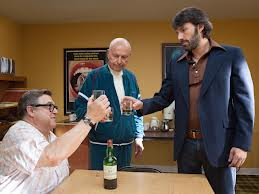
Honorary Mention- John Goodman: He is one of the most criminally underrated actors of all time (after Tim Roth, of course). He has never been nominated for an Oscar. This year he appeared in Trouble with the Curve, Argo, and Flight. In the last two, he gave performances that were as good as any on this list. His best was in Flight, where he plays Denzel Washington's friend/drug dealer. Comic brilliance. 

Should Win- Robert De Niro: Here, De Niro plays a controlling man with OCD and an addiction to gambling and football. On the surface, he is extremely unsympathetic. But De Niro unearths a caring father and protective husband. It's wonderful to see him in such great shape even 40 years after Mean Streets. 

Will Win- Tommy Lee Jones: Again, the Academy adores grandiloquent speech. However, Jones' best scene comes at the end of the film, after all the speechifying, as he shares a quiet, loving moment with his wife. 

Best Actress in a Supporting Role
Amy Adams (The Master)
Sally Field (Lincoln)
Anne Hathaway (Les Miserables)
Helen Hunt (The Sessions)
Jacki Weaver (Silver Linings Playbook)

Should Win- Amy Adams: She made The Master bearable. That alone deserves glory, praises, and a trophy on top. Icy and unyielding are the words that come to mind in describing her character. Adams plays Peggy, the wife of Lancaster Dodd, the man who begins and heads  a Scientology-like cult. Dodd is sham. The film exposes him, and his false beliefs. It is implied, however, that she is the mastermind behind the cult. She is shrouded in mystery which the film does not try to solve. It is frightening. 

Should NOT Win (but will win anyway)- Anne Hathaway: The more I think about it, the more I despise her performance. No, the performance is fine. Its the director I can't stand. Tom Hooper made Anne Hathaway get into a coffin and sing about the horrible life she is living while she is being violated. All of this he filmed in one, suffocating long take/closeup. Creepy. All it needed was a little distance. I did not need to be crammed in the coffin with her. Its a shame, because Anne Hathaway is extremely talented and deserved better.

Random Thoughts
- I might expand this post but for now, here's some others I think should win.
Best Animated Film- Brave should win, Wreck it Ralph will win. 
Best Cinematography- Skyfall should win, Life of Pi will win. 
Best Film Editing- Zero Dark Thirty should win, Argo will win. 
Best Score- Lincoln (John Williams) should win, Life of Pi will win. 
Best Song- Skyfall (Adele Adkins) same thing goes for Adele. 
Best Special Effects-The Avengers should win, Life of Pi will win 
Best Adapted Screenplay- Silver Linings Playbook should win and could win, but it's too close to call between it and Lincoln.  
Best Original Screenplay- Moonrise Kingdom should win, Amour will win.
Best Documentary- should and will win Searching for Sugar Man 

Sunday, January 27, 2013

The Truthfulness of the Cinematic Image Part I: A Moment of Innocence


In every film there is an understanding by the audience that they are watching a story, or a collection of sound an images, from the point of view of a director. Even documentaries do not necessarily show the truth. A documentary comes closer to the truth than most fictional films, but it is still the product of the vision of one director. Most films leave the question of truth at that. The audience knows it is watching the film from the point of view of another person, but whatever happens in the narrative, inside of the world the director created, is normally taken at face value. In the film Rashomon, which I will look at in Part II, Akira Kurosawa goes beyond, to explore the question of the truthfulness of the individual, through the use of flashbacks, which he accomplishes in a purely fictional film. In A Moment of Innocence, Mohsen Makhmalbaf starts off with an actual, documented historical event, and from there he tries recreate it, mold it into what he dreamed the truth could have been, and what he currently wishes it had been. 

Mohsen Makhmalbaf was a young Iranian revolutionary who stabbed a police officer to get his gun, then steal a bank and give away the money to support his cause. It seems that over time, he became regretful of what he did, and made a film to express his feelings. Part of his plan was to recreate, with young actors, the scene of the stabbing. A Moment of Innocence ends with the pivotal moment in which the young Makhmalbaf is supposed to stab the officer, but he backs off, and instead offers the officer some bread. Simultaneously, the young officer, with the knowledge that he would be attacked, hands him a flower. In one of the most shocking final shots in all of cinema, the frame freezes, and the audience is left looking at the image of two sworn enemies making peace with one another as the credits roll by slowly. The audience should not feel cheated. This moment of innocence is false in that it did not correspond to what happened to Makhmalbaf in real life, but it is also true and sincere because it did not violate the integrity of the story, or the characters. Both the young Makhmalbaf and the young police officer within the film had expressed their doubts about the upcoming incident. In fact, when young Makhmalbaf was supposed to stab the officer the first time, he broke down in tears, and could not go through with it. The final moment fits in well with the larger narrative of these two innocent characters. It is an example that we are watching the vision of the real Makhmalbaf, the director ex-revolutionary, who now wishes he had taken a moment, like the young hero of the film, to think about what he was going to do and change his mind. The final moment is what he now wishes the truth would have been.

Makhmalbaf goes further in exploring the truth of the cinematic image. Within A Moment of Innocence, the film of Makhmalbaf the director, is a false documentary concerning Makhmalbaf, the character, trying to recreate the incident that changed his life. Although it is not immediately obvious, there are several signs that show this is a “mockumentary.” First is the clapperboard which appears before several scenes. It makes the upcoming scene seem like an outtake, in which the actors normally get out of character, and “play themselves.” For example, in one scene, the police officer turned actor is filmed saying that he wants to play himself. That is a natural reaction, it feels unscripted, like it would not be in a fiction film. Also, there is a scene in the beginning in which the police officer goes looking for Makhmalbaf at his home. In a real documentary, there would be no one filming this part of the story, but since the scene is taking place within Makhmalbaf actual fictional feature film, Makhmalbaf is there filming it, giving a subtle hint to his audience that the scene is staged. Most of the film takes place at this level, in the “mockumentary” concerning the making of a film recreating the stabbing. Therefore, the scenes portraying Makhmalbaf and the officer training their younger selves should be taken at face value, as any other film should. The characters we see are two men defeated, who were humiliated in their youth, and have the chance to go back to the pivotal event which changed their lives. Both characters are angry, Makhmalbaf for failing in his mission, and the officer for letting himself be fooled by a girl who merely pretended to love him. Perhaps, these characters are versions of the actual officer and Makhmalbaf who were, at that time, working together to make the film. The real people seem to have overcome this event, but their characters, played by themselves, are part of an elaborate “what if” fantasy where they could go back and do complete their missions right. That is why the Makhmalbaf character urges his younger self to go through with the stabbing, and why the officer tells his younger self to shoot anyone who comes near. The characters, like many characters in several films, can be seen as projections of the actual filmmakers and can therefore claim some semblance of truth. 

Verdict- 3.5/4
A Moment of Innocence (1996) 1h 18min.

Note- Unfortunately A Moment of Innocence is almost impossible to find since the distributor went bankrupt. However, Rashomon, which I will write about in Part II, is easily available and I highly recommend buying/renting it.

Friday, January 18, 2013

Zero Dark Thirty


Zero Dark Thirty begins, as any other movie, with the logos of the production companies that made and distributed it. No one cares about them. Judging by the amount of chatter in the audience, they could almost be regarded as part of the countless trailers, not as part of the movie. Then, Kathryn Bigelow, the director, does something highly unusual. The screen fades to black, leaving the audience in a completely dark and silent environment. Bigelow has the film begin not with an image, but with sound. Some white noise. A woman's distressed voice. She is a victim trapped inside one of the twin towers, making a 911 emergency call. The building collapses. White noise. Those chilling, harrowing opening moments earned everyone's undivided attention. There were no phones, and no lights. No one could be heard talking or eating popcorn. This was, at the same time, the most peaceful and distressing movie going experience I have had in years. 

The movie becomes a procedural. It follows, in detail, the decade-long hunt for Osama Bin Laden by Maya (Jessica Chastain), a young CIA operative. While watching the film, I kept thinking of David Fincher's  Zodiac which followed the still unresolved investigation of the Zodiac killer. While making the film, Fincher believed that he had to get everything exactly as it happened. If the information he wanted to use for the film was not in the police reports, he discarded it immediately. I do not know what details of the investigation are accurate in Zero Dark Thirty.  I do know, however, that the way Maya gains, analyzes and builds upon the evidence she finds feels authentic. Even if elements of the real search were altered, the search onscreen is immensely detailed, convincing, and engaging.  What else can one ask from a fiction film


When asked by the CIA director what other tasks she had accomplished for the agency, Maya answers that she had done nothing else. We learn she had been recruited right out of high school with the sole task of hunting Osama Bin Laden. It is fascinating to see how Maya's obsession grows over the course of the film as she carefully and repeatedly reviews documents, videos, pictures, and just about any piece of information that might lead to Bin Laden's location while at the same time alienating all friends and coworkers. At one point, Maya starts writing  on the window of her boss's office the number of days the CIA has known the location of Bin Laden without taking action.
"I know certainty freaks you guys out, but its 100%"

Not only is Maya obsessed with every aspect of the hunt, but she is certain that she is right 100% of the time. She is not hesitant to confront her bosses when they are making mistakes, or to discard popular leads she think will go nowhere while laboring over seemingly inconsequential pieces of evidence no one in the CIA thinks are worth exploring. Maya could come off as highly unlikeable, but she doesn't because she somehow manages to be  right 100% of the time. Her superiors recognize it, the audience recognizes it, and that is why we bear with her for 2 1/2+ hours (or, in the case of her superiors, 10 years). 

The film reaches its climax with the raid on Bin Laden's compound. It is not an overwhelming, fast paced action sequence. Instead, like the film itself, it is deliberate, methodical, and full of nearly unbearable suspense. The most effective bits from the sequence are the point of view shots of the marines (shown through green night vision goggles) as they slowly unlock doors, clear hallways, search rooms, and get ever closer to Osama Bin Laden.  


The chase and the raid are so thoroughly realized that once Bin Laden is killed, his death feels almost anti-climactic. The film shows all of the sacrifices made, all of the lives lost in the search for this one man. By the end it asks the question, was it was worth the trouble?  "I thought there would be cheering," commented a friend of mine who saw the movie with me. Again, not one member of the audience made a sound while exiting the theatre. 


Jessica Chastain is incredible in showing Maya's determination and unwillingness to give up or slow down the pace of her investigation even after multiple near death experiences and assassination attempts. Maya keeps up this hardcore facade until the very last moments of the film. The change in Maya after Bin Laden's death, conveyed wordlessly by Chastain, is astonishing. A question is posed to Maya, as well as to the audience. Now that Bin Laden is dead, "where do you want to go?" 


Verdict- 4/4
Zero Dark Thirty (2012) R 2h 37min. 
screenshots from http://trailers.apple.com/trailers/sony_pictures/zerodarkthirty/

Sunday, January 6, 2013

Les Miserables


The first shot of "Les Miserables" is an extreme long shot of a massive wooden ship. The camera tracks past the ship to reveal prisoners pulling on ropes to haul the ship back to the docks. Slowly, the camera pushes in on one prisoner, 24601, otherwise known as Jean Valjean. The shot effectively shows the system under which French citizens were forced to live by during the early 1800s after the first revolution. It shows Valjean as a man who served over a decade for stealing a loaf of bread. he is just one of thousands who probably committed such petty crimes while people like the innkeepers got away safely time after time. The shot also allows the audience to see the world these people inhabit, the great ships, stone walls, the inspector Javert standing over all, on the pouring rain, and the French tricolor flag discarded on the ground, broken. We feel the injustice of their world, we are given the cause for revolution, we are given the visual splendor and rottenness of the world these characters live in. But then, the camera pushes closer and closer on Valjean's face and the wonderful world (and film) the first shot promised disappears.

 Throughout the film, director Tom Hooper just shows the face of the character singing (rarely speaking) song after song, monologue after monologue. Hooper placed all his faith on his actors. This method could work, but it needs both good actors and great singers. The beginning of the film follows Fantine closely and she illustrates how well Hooper's method could work, especially when she sings "I Dreamed a Dream." Hathaway find the emotional black hole in which Fantine is trapped. The pain is only too visible in her face. It's heartbreaking. The rest of the film, however, never lives up to the expectations created at the start. The most obvious example is Javert (Russell Crowe) who, by far, has the weakest voice, but on the extended solos of Valjean, Hugh Jackman's voice sounds on the verge of breaking.

 The film tried to be groundbreaking and revolutionary but it feels small and weak. It could have worked nicely as a traditional musical with a stronger, pre-recorded soundtrack, big Hollywood sets, matte paintings etc. After the ship in the beginning, the CGI is terrible. Paris looks muddy, but not in the way early nineteenth century Paris should be. The only bits and pieces we get of Paris are mostly at night where it looks like a dark, indistinct labyrinth. The benefits of film is that it is not constricted to the small stage. Les Miserables did not take advantage of that. the Thenardiers, for example, represent, in the play, the widespread filth and corruption of society at the time, but in the film they seem more the exception than the rule. There is also a scene where young revolutionaries despair since the people did not rise to their aid. My only complaint is, what people? If I had gotten a sense that these characters inhabited a larger world, I would have cared more deeply about this moment, one of the most affecting in the play. The film tries to be faithful to the format of the play to such a degree that it discards the benefits of a cinematic adaptation. Les Miserables should feel epic, not constrained.
Painting the background, the one aspect of theatre that could have helped the film most. 

Verdict- 2.5/4
Les Miserables PG13 (2012) 2h 38min.


Random Thoughts
- I like the image of Javert always walking on brink of buildings, but always on top of his world. He set his moral code, his strict rules and expects everyone to live by them. Valjean forgave him but in doing so violated Javert's world view in which only one of them could live. He lost, so, according to him, he had to go. Reminded me of the final suicide in  "In Bruges."
- Russell Crowe and Hugh Jackman are still great actors and gave excellent performances but their voices are too distracting.
- "Master of the House" was too grotesque for my taste. It should have been more enjoyable.
- screenshots from http://trailers.apple.com/trailers/universal/lesmiserables/ and http://www.blu-ray.com/movies/The-Wizard-of-Oz-Blu-ray/7703/#Overview